> ## Documentation Index
> Fetch the complete documentation index at: https://docs.opensourcemalware.com/llms.txt
> Use this file to discover all available pages before exploring further.
# API authentication with Bearer tokens
> Learn how to generate an API token from your profile settings and pass it correctly in the Authorization header for every API request.
Every request to the OpenSourceMalware API requires a valid API token. Tokens are tied to your account, are prefixed with `osm_`, and are passed as a Bearer token in the `Authorization` header. There is no OAuth flow. Authentication is a single header on every request.
## Getting a token
Go to [opensourcemalware.com](https://opensourcemalware.com/auth) and sign in.
Click your avatar in the top-right corner and select **Settings**.
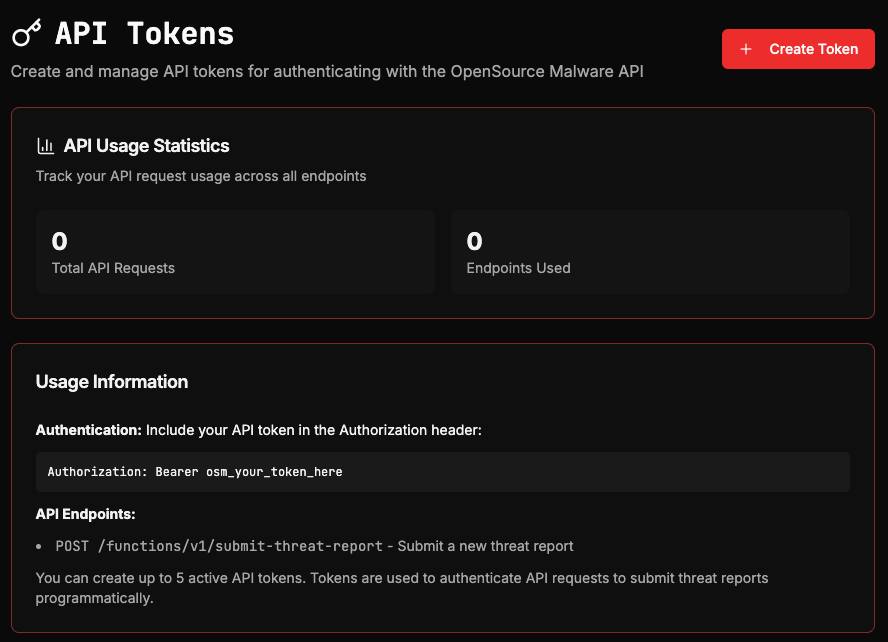
Navigate to the **API Tokens** section and click **Create Token**. Copy the token immediately (it's only shown once).
 Keep your API token secret. Do not commit it to source control, include it in client-side code, or share it publicly. If your token is compromised, revoke it immediately from your profile settings and generate a new one.
## Using your token
Pass the token in the `Authorization` header of every request:
```text theme={null}
Authorization: Bearer osm_your_token
```
```bash cURL theme={null}
curl -H "Authorization: Bearer osm_your_token" \
"https://api.opensourcemalware.com/functions/v1/check-malicious?report_type=package&resource_identifier=my-pkg&ecosystem=npm"
```
```python Python theme={null}
import requests
headers = {"Authorization": "Bearer osm_your_token"}
params = {
"report_type": "package",
"resource_identifier": "my-pkg",
"ecosystem": "npm"
}
response = requests.get(
"https://api.opensourcemalware.com/functions/v1/check-malicious",
headers=headers,
params=params
)
print(response.json())
```
```javascript Node.js theme={null}
const response = await fetch(
"https://api.opensourcemalware.com/functions/v1/check-malicious?report_type=package&resource_identifier=my-pkg&ecosystem=npm",
{
headers: {
Authorization: "Bearer osm_your_token",
},
}
);
const data = await response.json();
console.log(data);
```
## Invalid or missing tokens
If your token is missing, malformed, or has been revoked, the API returns a `401 Unauthorized` response:
```json theme={null}
{
"error": "Unauthorized",
"message": "Invalid or missing API token."
}
```
Keep your API token secret. Do not commit it to source control, include it in client-side code, or share it publicly. If your token is compromised, revoke it immediately from your profile settings and generate a new one.
## Using your token
Pass the token in the `Authorization` header of every request:
```text theme={null}
Authorization: Bearer osm_your_token
```
```bash cURL theme={null}
curl -H "Authorization: Bearer osm_your_token" \
"https://api.opensourcemalware.com/functions/v1/check-malicious?report_type=package&resource_identifier=my-pkg&ecosystem=npm"
```
```python Python theme={null}
import requests
headers = {"Authorization": "Bearer osm_your_token"}
params = {
"report_type": "package",
"resource_identifier": "my-pkg",
"ecosystem": "npm"
}
response = requests.get(
"https://api.opensourcemalware.com/functions/v1/check-malicious",
headers=headers,
params=params
)
print(response.json())
```
```javascript Node.js theme={null}
const response = await fetch(
"https://api.opensourcemalware.com/functions/v1/check-malicious?report_type=package&resource_identifier=my-pkg&ecosystem=npm",
{
headers: {
Authorization: "Bearer osm_your_token",
},
}
);
const data = await response.json();
console.log(data);
```
## Invalid or missing tokens
If your token is missing, malformed, or has been revoked, the API returns a `401 Unauthorized` response:
```json theme={null}
{
"error": "Unauthorized",
"message": "Invalid or missing API token."
}
```